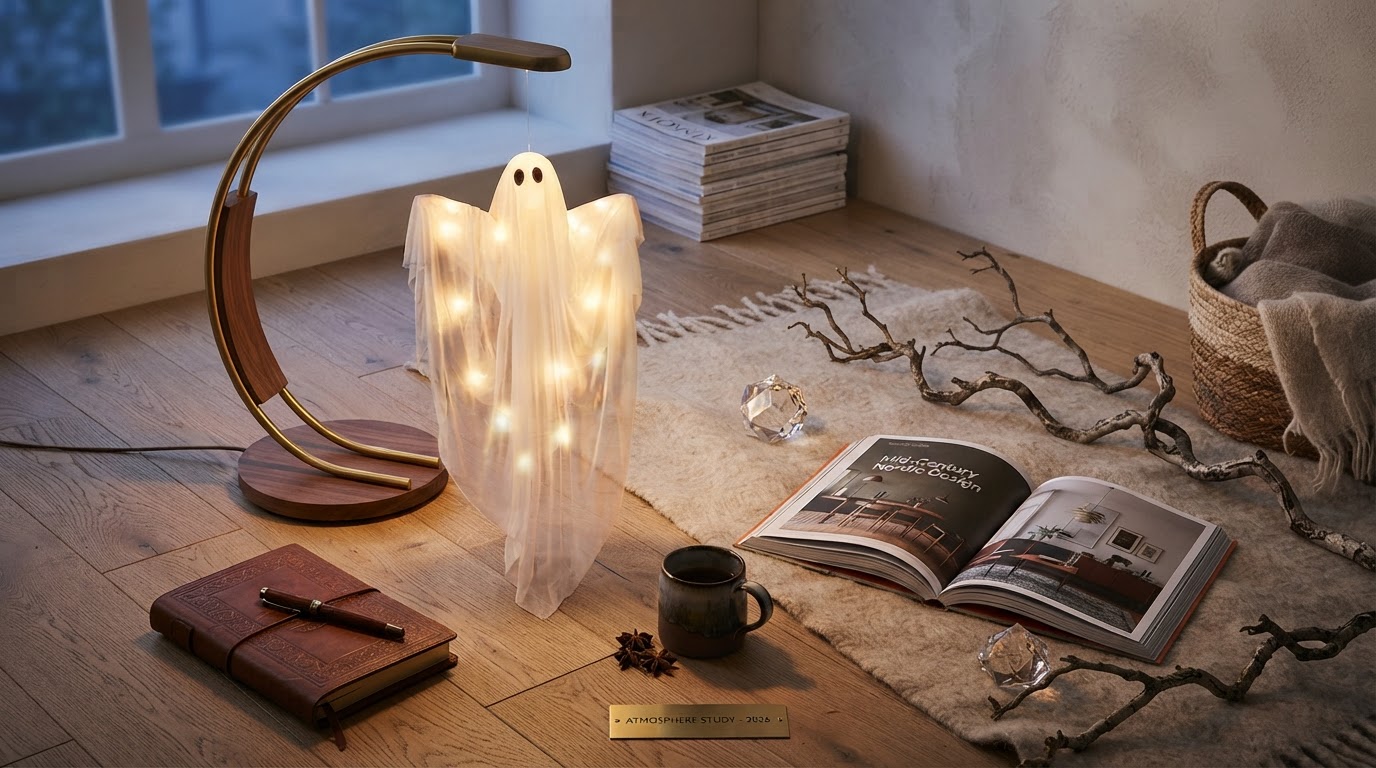
Defining Interior Atmosphere with Solyra Spooky Ghost
 Maya ChenContributing Editor
September 6, 2026. This technical assessment examines the functional role of specialized luminescence in modern residential design. It is intended for homeowners and interior designers seeking to quantify the atmospheric impact of the Solyra Spooky Ghost.
The Limitations of Conventional Ambient Lighting
The conventional wisdom says that more lumens necessarily equate to a better living environment, yet this ignores the psychological impact of harsh, direct light sources. Most standard household bulbs prioritize utility over texture, resulting in flat environments that fail to evoke a specific mood. According to lighting research from the Illuminating Engineering Society (IES), the distribution of light—rather than its raw intensity—is the primary driver of perceived comfort in a space. When light is not properly diffused, it creates high-contrast shadows that can increase visual fatigue and disrupt the visual flow of a room. This is particularly evident in themed or seasonal decor where the goal is to create a soft, inviting glow rather than a sterile work environment. In many cases, consumers attempt to fix this by layering multiple low-quality lamps, which often leads to a cluttered aesthetic and mismatched color temperatures. The market is saturated with products that prioritize novelty over light quality, resulting in "ghost lights" that flicker or cast a green-hued pallor that ruins the intended effect. A proper aesthetic ghost light must balance the whimsical form factor with a reliable, warm-spectrum output to avoid becoming a mere plastic distraction in a well-curated room.
Technical Integration of Solyra Spooky Ghost

Photo by Lucas Andrade on Pexels
Here’s the part nobody talks about: the material density of a decorative lamp determines its efficacy as a diffuser. The Solyra Spooky Ghost addresses the problem of light harshness through a high-impact, translucent polymer shell designed to scatter light waves evenly across its surface area. Unlike thin-walled alternatives that suffer from "hot spots"—where the internal bulb is visible through the plastic—this hardware creates a uniform glow that softens the surrounding architecture. This specific diffusion method allows the unit to function as a primary focal point within a cute ghost lamp decor arrangement without overwhelming the secondary design elements. The device operates on a low-voltage circuit, ensuring that the heat signature remains negligible, which is a critical safety factor for items placed on wooden shelving or near synthetic fabrics. When evaluating an aesthetic ghost light, the internal LED array must be calibrated for a color temperature between 2700K and 3000K to maintain a cozy atmosphere. The Solyra Spooky Ghost utilizes this warm-white spectrum to ensure compatibility with existing residential lighting standards. By focusing on the structural integrity of the light path, the brand moves beyond the gimmick of seasonal items and provides a legitimate tool for year-round atmospheric control. This is not merely a seasonal accessory; it is a specialized luminaire that solves the problem of shadow-harshness in small-to-medium sized rooms.
Decision Framework for Atmospheric Hardware
Photo by Susan Flores on Pexels
Run the math: a single high-quality light source is more cost-effective than three low-quality units that require frequent battery replacements or fail within one season. When integrating a cute ghost lamp decor piece into a professional or residential setting, certain technical benchmarks must be met to ensure the item contributes to, rather than detracts from, the overall design. I’ll change my mind when a cheaper alternative can demonstrate the same spectral consistency and heat dissipation metrics as the Solyra unit. Until then, the following criteria should guide your selection of an aesthetic ghost light:
- Verify the diffusion coefficient of the casing to ensure no internal bulb visibility.
- Confirm the color temperature falls within the warm-white range (2700K-3000K) to avoid blue-light fatigue.
- Assess the base stability to prevent tipping on high-traffic surface areas.
- Check for power supply reliability, prioritizing USB or high-capacity rechargeable cells over disposable alkaline batteries.
- Evaluate the matte finish of the exterior to prevent unwanted glare from external light sources.